
Retirement Plan Options for High-Income Business Owners: The Complete Comparison
Every retirement plan available to high-earning business owners, compared side by side, with 2026 contribution limits, tax savings scenarios, and a clear framework for choosing the right one.
If you're a business owner earning $500,000 or more per year, the retirement plan conversation rarely starts in the right place. Most business owners default to a 401(k), because that's the plan everyone knows. A few have a SEP-IRA. Almost none are using the plans that would actually make a meaningful difference to their tax bill and their retirement wealth.
That gap isn't a failure of ambition. It's a failure of information. The plans that deliver the most for high earners are also the least well understood, and the least likely to come up in a standard conversation with a generalist financial advisor.
This guide changes that. We'll walk through every retirement plan option available to small business owners in 2026, what each one does, what it costs, what it limits, and when it makes sense, so you can make a genuinely informed decision about where your retirement strategy should go.
"For a high-earning business owner, choosing the wrong retirement plan isn't just a missed opportunity. It's a recurring annual tax bill that compounds for decades."
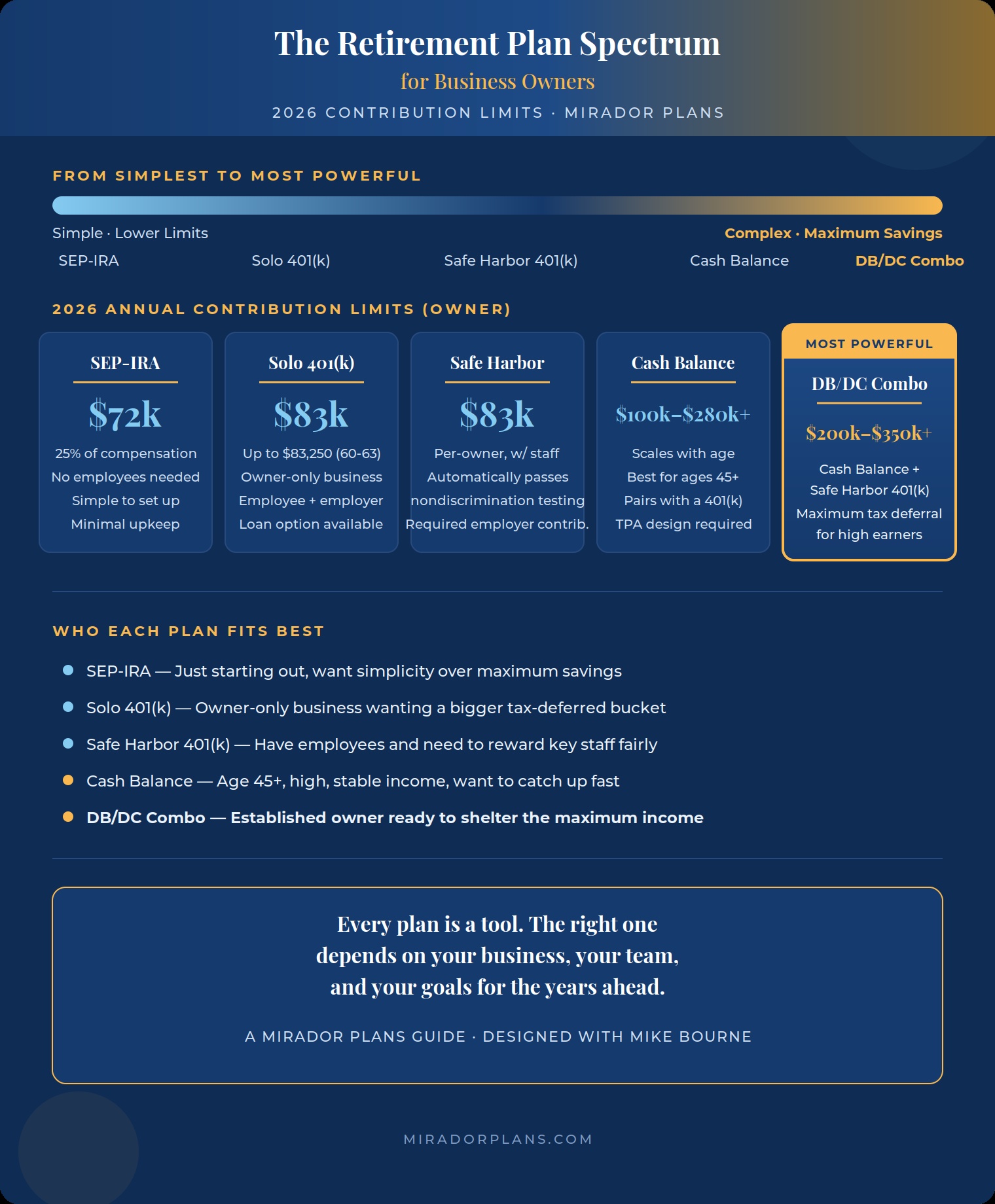
1. Why the Standard 401(k) Falls Short for High Earners
The 401(k) is an excellent retirement vehicle, for the right income level. For someone earning $150,000 a year, maximizing a 401(k) is a meaningful strategy. For someone earning $600,000, it's a rounding error.
In 2026, the total 401(k) contribution limit, including employer contributions and profit sharing, is $70,000. For an owner 50 or older, add the $7,500 catch-up contribution for a ceiling of $77,500. At a 37% federal marginal rate, that generates roughly $28,600 in federal tax savings.
On a $600,000 income, that's a 4.8% reduction in taxable income. For someone paying combined federal and California state taxes approaching 50% on upper income, the money left on the table is substantial. The 401(k) was not designed with this owner in mind.
The plans that were designed for high earners, defined benefit and cash balance plans, remain the most underutilized tools in the small business retirement toolkit, largely because they require a specialized TPA to design and administer them and rarely come up in a standard financial planning conversation.
The Core Insight
Every retirement plan discussed in this guide reduces taxable income dollar-for-dollar. The difference between plans is simply how many dollars you're allowed to move. For high earners, that ceiling matters enormously.
2. SEP-IRA: Simple, But Limited
The Simplified Employee Pension IRA is the most straightforward retirement plan available to self-employed individuals and small business owners. There's no complex setup, no annual administration filings for small plans, and contributions can be made up until the tax filing deadline, making it a popular choice for sole proprietors who want a quick solution.
How It Works
The employer contributes up to 25% of each eligible employee's compensation, with a 2026 maximum of $70,000. For a self-employed individual, the calculation adjusts slightly based on net self-employment income, but the effective limit is similar. Contributions are immediately 100% vested.
The Catch for High Earners
To hit the $70,000 maximum on a SEP-IRA, you need at least $280,000 in W-2 compensation (25% × $280,000 = $70,000). Owners earning $500,000 or more are leaving the majority of their potential deduction capacity unused with a SEP-IRA alone. There's no catch-up contribution for those 50 and older, and there's no Roth option.
If you have employees, the SEP-IRA requires the same contribution percentage for all eligible employees, which can make it expensive and inflexible as a business scales.
SEP-IRA at a Glance, 2026
Max contribution: $70,000 (25% of comp)
Catch-up (50+): None
Roth option: No
Employees required: Same % contribution for all
Best for: Solo owners, variable income, simplicity above all
3. Solo 401(k): The Best Single-Plan Option for Solo High Earners
For business owners with no full-time employees other than a spouse, the Solo 401(k), also called an Individual 401(k) or Self-Employed 401(k), is the most powerful single-plan option available. It has the same $70,000 total limit as the SEP-IRA, but the structure of how you get there is significantly more advantageous for high earners.
Why It Outperforms the SEP-IRA
A Solo 401(k) allows two types of contributions that add together to reach the $70,000 ceiling:
- Employee deferral: Up to $23,500 in 2026 (plus $7,500 catch-up for age 50+, or $11,250 super catch-up for ages 60–63 under SECURE 2.0)
- Employer contribution: Up to 25% of W-2 compensation
This means an owner earning $100,000 in W-2 wages can contribute $23,500 (employee deferral) + $25,000 (25% employer) = $48,500, already well ahead of what a SEP-IRA would allow at that income level. The SEP-IRA at $100,000 would cap at $25,000.
Roth Option and Loan Provisions
Many Solo 401(k) plan documents allow Roth contributions, meaning after-tax dollars that grow and are distributed tax-free. This can be valuable for owners who anticipate higher tax rates in retirement or want tax diversification. Some plans also allow participant loans, an option unavailable in a SEP-IRA or IRA.
Solo 401(k) at a Glance, 2026
Max contribution: $70,000 total (employee deferral + employer contributions)
Catch-up (50+): $7,500 | Ages 60–63: $11,250 (super catch-up)
Roth option: Yes (plan-document dependent)
Employees: Owner and spouse only
Best for: Solo practitioners, owners wanting Roth flexibility, income under $400k
4. Safe Harbor 401(k): The Foundation for Businesses With Employees
Once a business has employees, the retirement planning picture becomes more structured. A standard 401(k) requires annual nondiscrimination testing to ensure the plan doesn't disproportionately benefit owners and highly compensated employees. If the plan fails testing, the owner may face contribution refunds, a significant disruption.
The Safe Harbor 401(k) solves this by requiring the employer to make a defined contribution to employees in exchange for automatic satisfaction of certain testing requirements. This protects the owner's ability to maximize their own deferrals regardless of how much or how little rank-and-file employees participate.
Safe Harbor Contribution Options
- Non-elective contribution: 3% of compensation for all eligible employees, whether or not they participate in the plan
- Basic match: 100% of the first 3% deferred, plus 50% of the next 2%, effective 4% for a 5% deferring employee
- Enhanced match: 100% match on the first 4% deferred
All Safe Harbor contributions must be immediately 100% vested. The employer contribution is required annually and cannot be removed mid-year.
5. Profit Sharing: Flexible, Stackable, Strategic
Profit sharing is an employer contribution added on top of a 401(k) plan, and it's one of the most versatile tools in retirement plan design. Unlike Safe Harbor contributions, profit sharing is entirely discretionary. The employer decides each year whether to contribute, how much, and how to allocate it.
The key strategic value of profit sharing is the allocation formula. Rather than requiring a flat percentage for all employees, a plan using a new comparability or cross-tested design can allocate larger percentages to certain groups, typically owners and key employees, while still satisfying nondiscrimination testing. When designed carefully, this allows owners to redirect a significant share of profit sharing contributions to themselves.
Profit sharing contributions count toward the $70,000 total annual addition limit under IRC Section 415. When combined with employee deferrals and Safe Harbor contributions, they can help reach the maximum efficiently.
Profit Sharing at a Glance, 2026
Max employer contribution: Up to 25% of compensation; total additions cap at $70,000
Required annually: No, fully discretionary
Vesting: Can include a vesting schedule (unlike Safe Harbor)
Best for: Adding flexibility to a Safe Harbor base; strategic allocation in combo plans
6. Traditional Defined Benefit Plan: Maximum Power, Maximum Commitment
A traditional Defined Benefit plan promises a specific monthly benefit at retirement, typically expressed as a percentage of final compensation multiplied by years of service. Contributions are calculated actuarially to fund that promised benefit, and the employer bears the investment risk.
For owner-heavy businesses with high, consistent income and a clear long-term ownership horizon, traditional Defined Benefit plans can allow the largest possible annual contributions of any plan type. The 2026 maximum annual benefit limit under IRC Section 415 is $280,000, and for older owners closer to retirement, funding that target in the remaining years requires very large contributions.
Where the Traditional DB Plan Is Most Powerful
The traditional Defined Benefit plan is most appropriate for owners who:
- Want to maximize contributions regardless of flexibility concerns
- Have very consistent, high income with minimal year-to-year variation
- Prefer a pension-style annuity benefit at retirement
- Are comfortable with a higher degree of long-term funding commitment
For most small business owners in today's market, however, the Cash Balance Plan offers similar, and in many cases higher, contribution potential with significantly more flexibility and transparency. The traditional DB plan remains the right answer for some owner profiles, but the Cash Balance Plan has become the dominant defined benefit vehicle for small businesses.
7. Cash Balance Plan: The High-Earner's Primary Tool
The Cash Balance Plan is a type of defined benefit pension plan, but it functions more like a large, employer-funded savings account. Each year, the participant's hypothetical account balance grows via two credits: a pay credit (the annual contribution) and an interest credit (a guaranteed return, typically around 5%).
For high-earning business owners, the Cash Balance Plan is typically the single most impactful addition to a retirement strategy. Unlike a 401(k), where contribution limits are fixed by law, Cash Balance Plan contributions are actuarially determined based on age, meaning older owners can shelter dramatically more income each year.
| Owner Age | Approx. Annual CB Contribution | Federal Tax Savings (37%) |
|---|---|---|
| 40–44 | ~$90,000–$110,000 | ~$33,000–$41,000 |
| 45–49 | ~$120,000–$155,000 | ~$44,000–$57,000 |
| 50–54 | ~$165,000–$200,000 | ~$61,000–$74,000 |
| 55–59 | ~$210,000–$255,000 | ~$78,000–$94,000 |
| 60–62 | ~$260,000–$280,000+ | ~$96,000–$104,000+ |
8. The DB/DC Combo: The Most Powerful Strategy Available
Pairing a Cash Balance Plan with a Safe Harbor 401(k) and profit sharing, commonly called a DB/DC Combo, is the single most effective retirement and tax reduction strategy available to high-earning small business owners. The two plan types have separate contribution limits, which means they stack rather than compete.
Here's what a 53-year-old business owner with stable income of $700,000 might achieve in 2026:
| Plan Component | 2026 Contribution | Tax-Deductible? |
|---|---|---|
| Cash Balance Plan | ~$190,000 | ✓ Yes |
| Safe Harbor 401(k), employee deferral | $23,500 | ✓ Yes (pre-tax) |
| 401(k) catch-up (age 50+) | $7,500 | ✓ Yes |
| Profit sharing | ~$39,000 | ✓ Yes |
| Total tax-deferred contributions | ~$260,000 | ✓ Yes |
At combined federal and California state marginal rates approaching 50%, $260,000 in deductions represents roughly $130,000 in tax savings in a single year. Compounded over a decade of high-income years, the wealth accumulation difference between an owner who uses this strategy and one who doesn't is measured in millions.
"The DB/DC Combo isn't a tax trick. It's a federally sanctioned, IRS-regulated retirement structure that rewards business owners for committing to their own retirement and their employees' future."
9. Full Side-by-Side Comparison: Every Plan in 2026
| Feature | SEP-IRA | Solo 401(k) | Safe Harbor 401(k) | Cash Balance | DB/DC Combo |
|---|---|---|---|---|---|
| 2026 max owner contribution | $70,000 | $77,500 | $77,500 | $100k–$280k+ | $200k–$350k+ |
| Plan type | DC | DC | DC | DB | DB + DC |
| Employees allowed | ⚠ Costly | ✗ Owner only | ✓ Yes | ✓ Yes | ✓ Yes |
| Annual funding required | ✗ No | ✗ No | ⚠ SH portion | ✓ Yes | ✓ Yes |
| Actuarial oversight needed | ✗ No | ✗ No | ✗ No | ✓ Yes | ✓ Yes |
| Roth contributions allowed | ✗ No | ✓ Yes | ✓ Yes | ✗ No | ⚠ DC portion |
| Contribution flexibility year-to-year | High | High | Moderate | Moderate | Moderate |
| Who bears investment risk | Owner | Owner | Employee | Employer | Both |
| Meaningful for $500k+ income? | ✗ No | ⚠ Partial | ⚠ Partial | ✓ Yes | ✓ Yes |
| Administrative complexity | Very low | Low | Moderate | High | High |
10. Tax Savings Scenarios by Income Level
The right plan changes significantly depending on your income level. Here's how the math works across three common business owner profiles, assuming a California resident at peak earning years:
Profile A: Solo Owner, $250,000 Net Income, Age 46
A Solo 401(k) is likely the right starting point. Maxing out at $70,000 generates approximately $35,000 in federal tax savings at the 32–35% bracket. A Cash Balance Plan is possible at this income level but the employee cost may reduce net benefit enough to make a standalone 401(k) more efficient. Worth modeling.
Profile B: Business Owner With 5 Employees, $450,000 Net Income, Age 51
A Safe Harbor 401(k) with profit sharing is the foundation. A Cash Balance Plan layered on top, sized for approximately $150,000 in annual contributions, could generate $75,000–$90,000 in combined federal and state tax savings annually. The DB/DC Combo becomes compelling here if employee demographics support efficient plan design.
Profile C: Physician, Solo Practice, $750,000 Net Income, Age 55
This is the profile where the DB/DC Combo delivers maximum impact. A Cash Balance Plan for approximately $230,000 stacked with a Safe Harbor 401(k) maximized at $77,500 generates total contributions of over $300,000. At combined marginal rates approaching 50%, that's $150,000+ in annual tax savings, redirected into a growing retirement account rather than to the IRS.
11. CalSavers and California Business Owners
California business owners with five or more employees face an additional consideration: CalSavers, the state-mandated retirement savings program. Under current law, employers who do not offer a qualified retirement plan must enroll eligible employees in CalSavers, a state-run Roth IRA program with a $7,000 annual contribution limit.
CalSavers is better than nothing. But it is not a retirement strategy. The contribution limit is minimal, employers have no control over plan design, and there is no employer contribution, meaning no tax deduction for the business.
Establishing any qualified retirement plan, even a simple Safe Harbor 401(k), satisfies the CalSavers mandate while delivering meaningfully better outcomes for both owners and employees. For high-earning owners in California, the tax savings from a well-designed plan will typically dwarf the cost of administration within the first year.
CalSavers vs. a Qualified Plan
CalSavers employee limit: $7,000/year, Roth IRA only, no employer contribution, no employer tax deduction
Safe Harbor 401(k): $23,500+ employee deferral, employer contributions deductible, owner can maximize
DB/DC Combo: $200,000–$350,000+ total deductible contributions for the right owner
12. How to Choose: A Decision Framework
The right retirement plan isn't the most complex one or the one with the highest possible limit. It's the one that aligns with your income, your workforce, your cash flow consistency, and your time horizon. Here's a practical framework:
Start Here
Income under $200k, solo or very few employees, want simplicity. Solo 401(k) or SEP-IRA. Build the habit first.
Growing Business
Income $200k–$500k, have employees, want flexibility. Safe Harbor + Profit Sharing foundation. Model a Cash Balance Plan.
Maximum Impact
Income $500k+, age 45+, stable profits, maxed 401(k). DB/DC Combo is essential. Every year without it costs real money.
Key Questions to Answer Before Choosing
- How consistent is your income? Defined benefit plans require annual funding. Variable income years create contribution pressure if the plan is sized too aggressively.
- How many employees do you have, and how old are they? Older employees require higher contributions on their behalf in a defined benefit plan. Your TPA should model the employee cost before you commit.
- What is your exit timeline? Cash Balance Plans are most valuable over a 5–10 year runway. Short-term owners (3 years or fewer to exit) should be cautious about sizing aggressively.
- What is your combined marginal tax rate? In California, combined federal and state marginal rates can approach 50%. Every dollar of deduction is worth twice as much here as in a no-income-tax state, making the DB/DC Combo even more compelling.
- Have you already maximized your 401(k)? If the answer is yes and your income is above $500,000, a Cash Balance Plan should be the next conversation.
Find the Right Plan for Your Business
Mirador designs and administers custom retirement plans for high-earning small business owners. We'll model your options, show you the numbers, and build a plan that's designed around your goals, not a template.
Talk to Mirador13. Frequently Asked Questions
What is the best retirement plan for a high-income business owner?
For owners earning $500,000 or more with consistent income and a 5+ year business runway, the DB/DC Combo, a Cash Balance Plan paired with a Safe Harbor 401(k), delivers the highest total tax-deductible contributions of any available structure, often $200,000 to $350,000+ per year depending on age. For younger owners or those with variable income, a Safe Harbor 401(k) with profit sharing is the right foundation to build from.
How much can a business owner contribute to a retirement plan in 2026?
It depends heavily on the plan type and the owner's age. A Solo 401(k) or SEP-IRA maxes at $70,000 ($77,500 with catch-up). A Cash Balance Plan alone can allow $100,000 to $280,000+ annually based on age. A DB/DC Combo can stack both for total contributions of $200,000 to $350,000+ in a single year. All contributions are tax-deductible.
What is the difference between a SEP-IRA and a Solo 401(k)?
Both have the same $70,000 total contribution ceiling in 2026, but the Solo 401(k) reaches that ceiling more efficiently at lower income levels because it combines employee deferrals and employer contributions. The SEP-IRA is funded entirely by employer contributions at 25% of compensation, requiring $280,000 in income to max out. The Solo 401(k) also allows Roth contributions and participant loans; the SEP-IRA does not.
What is a Safe Harbor 401(k) and do I need one?
A Safe Harbor 401(k) requires a mandatory employer contribution, typically 3% of compensation for all eligible employees, in exchange for automatic satisfaction of certain nondiscrimination tests. For business owners with employees, it's often the best foundation for a retirement plan because it protects the owner's ability to maximize their own contributions without risking refunds from failed testing. It also makes pairing a Cash Balance Plan significantly cleaner from a compliance standpoint.
Can I have a Cash Balance Plan and a 401(k) at the same time?
Yes, and this is exactly the DB/DC Combo strategy that delivers maximum results for high earners. The two plans have separate contribution limits that don't directly offset each other. A Safe Harbor 401(k) maximized at $77,500 for a 52-year-old, combined with a Cash Balance Plan sized at $185,000, produces total annual contributions exceeding $260,000, all tax-deductible.
What does CalSavers compliance mean for California business owners?
California requires businesses with five or more employees that don't offer a qualified retirement plan to enroll eligible employees in CalSavers, the state-run Roth IRA. Any qualified plan, even a basic Safe Harbor 401(k), satisfies the CalSavers mandate. For high-earning owners, establishing a real plan isn't just compliance, it's a dramatically better financial outcome than CalSavers alone.
Is a Cash Balance Plan right for a business with employees?
It can be, but the plan design matters significantly. Cash Balance Plans must pass nondiscrimination testing when employees are included, which means some portion of contributions must benefit employees. The cost depends on workforce age and compensation levels. A skilled TPA will model the employee cost before the plan is established so owners can make a fully informed decision about whether the net benefit to the owner justifies the design.
What happens to my retirement plan when I sell my business?
Defined benefit and Cash Balance Plans are typically terminated as part of a business sale, with participants rolling their accrued benefits into IRAs or the new employer's plan on a tax-deferred basis. 401(k) plans may be assumed by the buyer or terminated separately. Coordination with your TPA well before the sale closes is essential, the termination process for defined benefit plans involves regulatory procedures that take several months to complete properly.

