
When a business owner decides to offer a retirement plan, it’s a meaningful investment in the future, both for their team and for their own financial well-being. But with that decision comes a new set of responsibilities, deadlines, and regulatory requirements. That’s where a Third Party Administrator (TPA) like Mirador comes in.

What Is a TPA and Why Does It Matter?

A TPA, or Third Party Administrator, plays a critical role in the design, implementation, and ongoing management of retirement plans like 401(k)s. We’re the ones making sure the plan works, for your business, your people, and the IRS.

While the financial advisor focuses on investment options and the recordkeeper handles transactions, the TPA is responsible for how the plan is built and whether it complies with Department of Labor and IRS rules.

In the words of one Mirador expert featured in the video on this page:

“401(k) plans have to abide by a lot of IRS rules and regulations as well as DOL. And so there is a lot of compliance that comes into play. You have to file a Form 5500, you have to do nondiscrimination testing… you as a plan sponsor are responsible. Many plan sponsors, because it’s a lot of work, hire outside help, such as a 401(k) administrator or a third party administrator, where we are assisting you in making sure that you are in compliance with all of the regulations.”

The Business Owner’s Role: Plan Sponsor

When you offer a retirement plan, you’re not just doing something good for your team, you’re taking on the role of “plan sponsor.” That comes with fiduciary responsibility. You’re responsible for making sure the plan is fair, compliant, and properly managed.

This includes:

  • Offering a plan that doesn’t discriminate in favor of highly compensated employees
  • Filing required forms like the 5500
  • Ensuring deadlines are met for contributions, notices, and testing
  • Keeping the plan document up to date

But most business owners aren’t tax code experts. Nor should they be. That’s why TPAs exist.

What a TPA Does

At Mirador, we act as your technical expert and strategic partner in plan design. Here’s what that includes:

1. Plan Design

We don’t sell products, we build plans. That means we customize your 401(k) or defined benefit plan based on your goals: saving more for ownership, rewarding key employees, or staying ACA compliant. We ensure your plan structure maximizes flexibility and tax advantages.

2. Ongoing Compliance

We handle:

  • Annual nondiscrimination testing
  • Coverage and top-heavy testing
  • Form 5500 preparation
  • Required plan notices (Safe Harbor, QDIA, etc.)
  • Contribution limit calculations

We stay on top of IRS and DOL updates so you don’t have to.

3. Consultation and Adjustments

Life changes, and so do businesses. We help you adjust your plan as your headcount, structure, or goals evolve.

Why “Third Party”?

The term “Third Party Administrator” simply reflects the relationship: the business owner (first party) hires an outside expert (third party) to fulfill the responsibilities of plan design and administration. It’s still your plan. You’re still responsible. But with a qualified TPA like Mirador, you’re not doing it alone.

When It Matters Most

Compliance issues often surface long after a plan is in place, during an IRS audit, a failed test, or a missed deadline. That’s why having a proactive TPA is so important. We don’t just check boxes. We anticipate issues, design around your goals, and guide you through the full lifecycle of your plan.Bottom line: You’re responsible for the plan, but you don’t have to manage it alone. At Mirador, we make sure your retirement plan works as hard as you do.

When business owners acquire or merge with another company, the headlines focus on valuation, synergies, and closing timelines. But quietly sitting in the background, often unnoticed until it’s too late, are legacy benefit plans, control group structures, and compliance traps that can derail your deal.

Retirement plans are consistently one of the most commonly overlooked elements in M&A transactions specifically, how control group and affiliated service group rules can create unexpected liability, compliance issues, and contribution obligations unless proactively addressed before the transaction closes.

Why Retirement Plans Must Be on the M&A Due Diligence List

“We work with successful business owners who acquire companies to grow, but they rarely think about how that impacts their existing retirement plan design.”

Buying or merging with another company may trigger IRS rules around control groups or affiliated service groups (ASGs). When that happens, your new business structure may require that all employees across both entities be tested together, and possibly receive contributions under your existing retirement plan.

If the acquired business has its own plan, things become even more complicated. There may be testing failures, required plan mergers, and transition rules to follow.

Understanding Control Groups in M&A

A control group exists when:

  • You own 100% of your current business
  • You acquire at least 80% of another business

These businesses are now considered one entity for retirement plan purposes, even if you operate them separately.

What it means:

  • Employees in both companies must be included in nondiscrimination testing
  • You may have to offer benefits to newly acquired employees
  • If your current plan was designed for a lean staff, your contribution structure may need to change

Affiliated Service Groups: Less Ownership, Same Risks

An Affiliated Service Group doesn’t require 80% ownership. These groups are formed when:

  • Two businesses work closely together to provide services
  • Owners have overlapping management or operational control
  • There’s a financial or service-based dependency between the entities

This can create a testing and compliance requirement even when the acquiring company owns less than 80% of the other.

Why Timing Matters

“We designed your plan for the life you had when we started, your structure, your staff, your ownership. If that changes, the plan needs to change too. But once you close the deal, your options become limited.”

Amendments can’t be retroactive. If the new company structure results in a failed nondiscrimination test, you may be required to fund employee contributions you hadn’t budgeted for. That’s why retirement plan review should happen before the transaction closes, not after.

M&A Compliance Checklist for Business Owners

Below is a checklist of what to review during any merger or acquisition:

Corporate and Operational Structure

  • Ownership percentages post-transaction
  • Whether common ownership triggers a Control Group or ASG
  • Number of employees and employee classifications

Retirement Plan Considerations

  • Whether the acquired company has an active plan
  • Plan document availability and filing history (Form 5500)
  • Testing compatibility and transition rules
  • Whether a plan merger is advisable or necessary

Insurance and Risk Transfer

  • Review or add Directors & Officers (D&O) coverage
  • Errors & Omissions (E&O) policy alignment
  • General liability, workers’ compensation, and commercial auto review

Employee Benefits

  • Group health plan compatibility
  • COBRA compliance transition
  • Ancillary benefit obligations

Professionals You Should Notify (and Involve Early)

Too often, business owners loop in advisors after the deal closes. That’s too late for plan design. Here’s who should be at the table before the transaction is finalized:

  • ERISA Attorney – for plan document review, compliance, and amendment timing
  • Third Party Administrator (TPA) – for testing, filings, and plan design updates
  • CPA – for tax implications of employer contributions and deduction strategy
  • Wealth Advisor – to align plan changes with long-term retirement strategy
  • Business Transaction Attorney – for deal structure, reps, and warranties related to benefit plans
  • HR/Benefits Team or Consultant – for post-close onboarding and communication

Retirement Plans Aren’t a Footnote

If you’re acquiring or merging businesses and haven’t reviewed your retirement plan design, you’re missing a key element of due diligence. The IRS and DOL won’t give you a grace period because you were unaware.

Get ahead of it. Confirm whether control group or ASG rules apply. Test before you transact. Adjust your plan before it’s too late.

If you’re sponsoring a retirement plan, especially a 401(k), profit-sharing, or defined benefit plan, nondiscrimination testing isn’t optional. It’s a compliance requirement with real financial consequences for plan sponsors and owners who don’t pay attention.

Let’s explore what nondiscrimination testing is, why it exists, who it protects, and how smart plan design can help you pass, while still maximizing owner contributions.

What Is Nondiscrimination Testing?

Nondiscrimination testing (NDT) is a set of IRS-mandated compliance tests designed to ensure that retirement plans do not unfairly benefit highly compensated employees (HCEs) at the expense of rank-and-file employees.

It applies to:

  • 401(k) and Safe Harbor plans
  • Profit-sharing plans
  • Defined benefit and cash balance plans
  • Combination plans (e.g., DB/DC)

In short, if you’re offering retirement benefits, the IRS wants to ensure you’re not only enriching owners and top executives while leaving everyone else behind.

Why Was It Created?

Nondiscrimination testing exists to protect employees.

“It’s to make sure you’re not giving way too much money to your CEO and executives when compared to your staff,” says Alison Quesada, Partner at Mirador.

It ensures fairness and plan qualification. A plan that discriminates in favor of HCEs risks disqualification by the IRS, which can result in:

  • Refunds of employee deferrals
  • Required employer contributions
  • Loss of tax-favored plan status
  • Costly corrections or audits

Who Needs to Pay Attention to Nondiscrimination Testing?

NDT isn’t just the responsibility of your TPA, it affects:

  • Business Owners: Because the structure of your contributions depends on passing these tests
  • HR and Finance Leaders: Who handle compliance documentation and employee communication
  • Advisors and CPAs: Who integrate retirement plan strategy into overall tax and compensation planning

If your plan includes both HCEs and rank-and-file employees (and most do), you’re subject to nondiscrimination testing.

Common Testing Areas

Here are the key tests most plans must pass annually:

ADP (Actual Deferral Percentage) Test

Compares how much HCEs and non-HCEs defer from their own pay into the 401(k).

ACP (Actual Contribution Percentage) Test

Compares employer matching and after-tax contributions between HCEs and non-HCEs.

Top-Heavy Testing

Determines whether key employees (e.g., owners, officers) hold more than 60% of total plan assets.

What Happens if You Fail?

Failing nondiscrimination testing can trigger:

  • Refunds to HCEs, forcing owners and execs to pull money out of their accounts
  • Additional employer contributions, to “rebalance” benefits to rank-and-file employees
  • Penalties and potential loss of plan qualification if not corrected in time

The good news? These failures are often avoidable, with the right plan structure.

Smart Design: Combining Plans to Satisfy Compliance and Maximize Value

As Rachel Rosner explains in the video, one of the most powerful ways to pass NDT and support both owners and employees is by combining plan types:

“We call them DB/DC or CB/DC combination plans. So it’s a defined benefit plan paired with a 401(k) profit-sharing plan.”

How It Works:

  • The defined benefit (DB) plan delivers large contributions for owners, designed around age, compensation, and years to retirement
  • The 401(k) profit-sharing plan offers visible contributions for employees on familiar investment platforms like John Hancock or American Funds

This structure not only passes nondiscrimination testing, it also serves as:

  • A tax strategy for owners
  • A retention tool for employees
  • A balanced benefit plan that satisfies IRS fairness rules

“While we say we set these plans up for the owners, it still is for the owners,” says Rosner. “But the employees get real value too.”

Watch the Video: Nondiscrimination Testing, Explained

Mirador Partners Alison Quesada and Rachel Rosner break down how testing works, who it impacts, and how we structure combination plans to meet compliance and contribution goals.

Dusk at a Mirador representing planning for retirement and 550 reporting's role

In 2025, California’s state-run retirement program, CalSavers, expands its reach to cover all employers with at least one employee. The final registration deadline is December 31, 2025.

While the law itself does not change in 2026, California will begin enforcing penalties for non-compliance, making 2025 a critical year for employers to take action.

Employer Requirements for 2025

By December 31, 2025, every California employer with one or more employees must comply with the CalSavers mandate, unless exempt. Employers have three options:

  • Offer a private-market plan. Employers can sponsor their own qualified retirement plan, such as a 401(k), 403(b), or SIMPLE IRA.
  • Register with CalSavers. Employers that do not offer a private plan must register for the state-run CalSavers program.
  • Certify exemption. Even if an employer already offers a qualified retirement plan, they must still register with CalSavers to formally certify their exemption.

Exemptions to the Mandate

Certain employers are not required to register with CalSavers, including:

  • Employers with no employees other than the business owners
  • Government entities
  • Religious organizations
  • Tribal organizations
  • Businesses that have closed or been sold

Penalties for Non-Compliance

Employers who fail to comply face escalating penalties:

  • First penalty: $250 per eligible employee if non-compliance continues 90 days after receiving notice
  • Second penalty: An additional $500 per eligible employee if non-compliance extends beyond 180 days

How the CalSavers Program Works

For employers that register with CalSavers, the program functions as follows:

  • Automatic enrollment: Employees are automatically enrolled in a Roth IRA with an initial contribution rate of 5% of their paycheck
  • Opt-out flexibility: Participation is voluntary for employees, they may opt out at any time
  • Employer role: Employers only facilitate payroll deductions; they do not contribute to employee accounts
  • Contribution limits: In 2025, Roth IRA contribution limits are $7,000 per year, plus an additional $1,000 for employees aged 50 and older

Why Many Employers Choose Private Retirement Plans Instead

While CalSavers offers a compliance pathway, it provides no employer tax benefits, no contributions, and limited employee savings opportunities. For many business owners, a private retirement plan is not only about compliance, it’s a tool for growth, retention, and tax efficiency.

Employee Benefits: Attract and Retain Top Talent

  • Competitive benefits packages, including 401(k) and Cash Balance plans, help employers stand out in a competitive labor market.
  • Retirement plans demonstrate a long-term investment in employees, increasing loyalty and reducing turnover.
  • Plan features such as employer matching, profit-sharing, or higher contribution limits make a meaningful difference to employees.

Employer Benefits: Tax Efficiency and Flexibility

  • Contributions to qualified retirement plans are generally tax-deductible to the business, reducing taxable income.
  • Employers can design plans that maximize their own retirement savings while still providing benefits to their employees.
  • By layering strategies like Cash Balance + 401(k) plans, owners and highly compensated employees can contribute well beyond traditional 401(k) limits while also funding employee accounts in a tax-advantaged way.

At Mirador, we specialize in custom retirement plan design that balances compliance with CalSavers while unlocking far greater advantages for both owners and employees.

Federal SECURE 2.0 Act Updates Affecting California Employers

Beyond CalSavers, employers must also pay attention to federal changes under the SECURE 2.0 Act, which impose new retirement plan requirements:

Effective in 2025

  • Automatic enrollment in new plans: Most new 401(k) and 403(b) plans must include automatic enrollment
  • Part-time employee eligibility: Employees working at least 500 hours per year for two consecutive years must be given access to the company’s retirement plan

Effective in 2026

  • Required Roth catch-up contributions: For employees aged 50 and older earning more than $145,000 in the previous year, all catch-up contributions must be made on a Roth (after-tax) basis

Key Takeaway for Employers

2025 is the year all California employers with at least one employee must make a decision: sponsor a private retirement plan, or register with CalSavers.

While CalSavers satisfies the legal requirement, it stops short of delivering the strategic advantages of a well-designed retirement plan. Employers who want to retain top talent, maximize their own retirement savings, and reduce taxes should consider private-market plan design, including Cash Balance and 401(k) combinations, as a stronger long-term solution.

Mirador helps business owners create retirement plans that do more than check a box, they build value for the business, the owner, and their employees.

When it comes to retirement plan compliance, ownership structures and related business relationships matter more than many business owners realize. A recent client case highlights why asking the right questions, and digging beyond the surface, can make all the difference.

A Real-World Example

When Mirador sat down with a prospective client, the structure looked fairly straightforward. The company had created a separate management and marketing entity where only the CEO, the COO (also the CEO’s spouse), and one additional employee were employed. Meanwhile, the main operating company employed about 50 staff. The defined benefit plan, however, was set up only for the smaller management company.

At first glance, this raised important questions:

  • Were these two companies truly independent?
  • Did ownership overlap in a way that created a controlled group?
  • Or was this an affiliated service group situation, where one company exists primarily to provide services to the other?

“The IRS assumes that if ownership is in the family, you have control. The only exception is between siblings.” – Mike Bourne

Attribution Rules and Controlled Groups

In the initial conversation, ownership was described as partly held by a “private investor.” Upon closer review, that investor turned out to be the business owner’s mother. This revelation mattered because of IRS attribution rules.

Under these rules, ownership is attributed among family members, spouses, parents, children, and grandchildren all count. The effect? Even if ownership is divided on paper, the IRS treats the entities as a single controlled group. The only family relationships excluded from attribution are siblings.

“Through attribution, family ownership is combined. Parents, spouses, children, and even grandchildren all count toward determining a controlled group.” – Mike Bourne

This meant the companies were not separate for retirement plan purposes. They had to be considered together.

Affiliated Service Groups: Closing Loopholes

The case also touched on another important concept: affiliated service groups (ASGs). These rules exist to prevent owners from carving out certain employees, such as administrators, nurses, or staff, into a separate company solely to exclude them from pension benefits.

Classic examples include physician practices that attempted to create separate service entities for non-physician staff, leaving only the doctors in the retirement plan. The IRS closed this loophole by defining ASGs: if one company provides essential services to another, and ownership ties exist, the employees must be treated as part of the same group for retirement plan purposes.

Why This Matters for Business Owners

For high-earning business owners, the stakes are clear:

  • Compliance – Failing to recognize a control group or affiliated service group can invalidate plan design and expose the business to penalties.
  • Fairness – The IRS requires that plans don’t disproportionately benefit owners at the expense of employees.
  • Strategy – With the right plan design, owners can still maximize contributions and tax savings while meeting compliance requirements.

“Affiliated service group rules exist to keep owners from excluding employees while still taking full advantage of retirement plan tax deductions.” – Rachel Rosner

Understanding how ownership and service relationships affect retirement plans is crucial. Without a comprehensive view, even well-intentioned plan designs can fall short, or worse, put businesses at risk.

Getting it Right the First Time

At Mirador, we’ve seen how complex these rules can be, and we know that getting them right is essential. Control groups and affiliated service groups aren’t just technical definitions, they directly shape how retirement plans must be structured, tested, and administered.

The right guidance ensures owners can capture the tax advantages of defined benefit or cash balance plans while keeping their plans compliant and their employees protected.

Ready to see how the right plan design can help you save on taxes, maximize retirement savings, and support your team? Reach out to our team to start the conversation.

For many employers, managing a retirement plan is one of the most important fiduciary responsibilities they take on. Among the most overlooked compliance risks is the timeliness of 401(k) contributions.

It is not just about following the rules. Delays in funding employee deferrals can impact participant outcomes, increase liability, and trigger costly corrections. Whether you are running a newly implemented plan or managing an established one, understanding the timing requirements and how to meet them is essential.

Why Timely Contributions Matter

Delayed contributions are a fiduciary breach

When employees elect to defer part of their wages into a retirement plan, those dollars must be deposited into the plan promptly. Once withheld from pay, these funds are no longer considered company assets. Failing to deposit them quickly violates ERISA (Employee Retirement Income Security Act) rules and can be seen as a misuse of employee money.

Missed deadlines trigger financial consequences

Late contributions often require plan sponsors to correct the error by calculating and depositing “lost earnings” for each participant. In most cases, the employer must also file a Form 5330 and pay a 15 percent excise tax on the late amounts.

These corrections are time-consuming, complex, and reportable to the IRS and Department of Labor.

What the IRS Requires

The 7-business-day rule for small plans

For plans with fewer than 100 participants, the IRS offers a clear safe harbor: if you deposit deferrals within seven business days of payroll, the contributions are deemed timely.

This rule provides clarity for small business owners and payroll teams, but it also sets a firm limit. Missing this window puts the plan out of compliance.

Large plans must act faster

For plans with 100 or more participants, the IRS applies a more subjective standard: contributions must be deposited “as soon as administratively feasible.”

In practice, this often means within two or three business days. The IRS may examine your payroll capabilities to determine what is feasible based on your internal processes. If you can move money quickly, they expect you to.

“If you are able to pay your employees on Friday, you should be able to also take those funds and put them into the 401(k) that same Friday or the following Monday.”

What Happens If You’re Late?

Late contributions do not go unnoticed. Plan sponsors must take the following steps to resolve the issue:

1. Identify affected payrolls

Every missed deadline must be tracked and documented. This is critical for both internal controls and regulatory reporting.

2. Calculate lost earnings

You must calculate the investment gains employees would have earned if their contributions had been deposited on time. These amounts must then be added to their accounts at the employer’s expense.

3. File and pay excise taxes

In most cases, the employer must file Form 5330 and pay a 15 percent excise tax on the late amounts. This is in addition to the lost earnings that must be funded into the plan.

4. Disclose and report

If the error is significant or systemic, the Department of Labor may require additional disclosures. The issue could also be flagged in the plan’s annual audit or Form 5500 filing.

Common Causes of Late Contributions

Understanding why late contributions happen can help prevent them:

  • Manual payroll processes: Plans that rely on manual file uploads or batch processing are more likely to miss deadlines.
  • Lack of internal controls: Without clear responsibility or oversight, contributions can fall through the cracks.
  • High staff turnover: Changes in HR or payroll roles often result in missed steps or knowledge gaps.
  • Unfamiliarity with rules: Many new plan sponsors are simply unaware of how strict the deadlines are.

These are all preventable with the right systems and support in place.

How to Stay Compliant

Set clear internal procedures

Build a routine around payroll and 401(k) deposits. Assign roles and establish backup procedures so contributions are never delayed due to vacations or staffing changes.

Automate whenever possible

Using automated payroll integration with your 401(k) provider reduces the chance of delay and improves accuracy.

Monitor your timeline

Keep a log of when contributions are withheld and when they are deposited. Regularly audit this timeline to ensure your process is consistent and within the required timeframe.

Partner with a proactive TPA

A good Third-Party Administrator (TPA) will not just manage your compliance after the fact. They will help you establish the right processes up front, monitor for late deposits, and guide you through corrections if needed.

How Mirador Helps

At Mirador, we know that plan sponsors have a lot on their plate. That is why we design retirement plan processes that fit your business, not the other way around.

If a deadline is missed, we help quantify the correction and guide you through the next steps. But more importantly, we work with you proactively to help prevent errors in the first place.

Whether you are managing your first plan or your fiftieth, our team brings deep expertise, steady support, and a commitment to getting it right.

Final Thoughts

Timely 401(k) contributions are not just a compliance checkbox. They are a reflection of your commitment to your employees and your fiduciary responsibility.

Missing a deposit deadline can quickly become a costly and time-consuming problem, but it is one that is entirely avoidable with the right systems and support.

If you are unsure whether your current process meets the timing requirements, let’s talk. Mirador can help you evaluate your current procedures, implement improvements, and stay confidently compliant.

The FBI is warning Americans about a new, highly coordinated scam that has already stolen more than a billion dollars, mostly from seniors. It’s called the Phantom Hacker scam, and it combines three familiar fraud tactics into one devastating scheme.

How the Scam Works

The Phantom Hacker scam unfolds in three phases, often over days or weeks:

1. Tech Support Impostor
It usually starts with a pop-up on your phone or computer claiming your device has been hacked. Victims are urged to call a “tech support” number. Once on the phone, the fake technician asks the victim to download software that gives them remote access. They’ll run a fake scan and warn that your finances may also be compromised, prompting you to open your bank or investment accounts.

2. Bank Impostor
Next, the victim receives a call from someone claiming to be from their bank’s fraud department. This scammer says foreign hackers have accessed the victim’s accounts and that funds must be moved to a “safe” account. Victims are then pressured to transfer money through wire transfers, cryptocurrency, or even cash shipments, which are difficult to trace or recover.

3. Government Impostor
Finally, another fraudster poses as a government official, sometimes from the Federal Reserve or another U.S. agency. They may send emails or letters on fake letterhead to make the scheme appear legitimate, while continuing to insist that funds must be transferred for protection.

Why It’s So Effective

This scam is especially dangerous because it plays on fear and urgency. Victims believe they’re acting to protect their savings, not realizing they’re being guided step-by-step into handing it over. Criminals even use artificial intelligence to make their messages sound more convincing, tailoring scams to people’s interests or online activity.

Red Flags to Watch For

  • Unsolicited contact: No legitimate tech company will reach out with a random pop-up or call.
  • Pressure to act quickly: Scammers insist on immediate action to prevent you from stopping to think.
  • Requests for remote access: Never allow a stranger access to your device.
  • Unusual payment methods: Wire transfers, crypto, and gift cards are favorite tools of scammers.
  • Secrecy: Being told not to discuss what you’re doing with friends or family is a major red flag.

Who Is Being Targeted?

While anyone can fall victim, seniors are most at risk. Many have significant retirement savings and may be less familiar with the latest scams. The FBI warns that in many cases, once money is gone, it’s nearly impossible to recover.

How to Protect Yourself and Loved Ones

  • Talk openly with family, especially older relatives, about scams like this.
  • Be cautious of any unsolicited call, email, or pop-up.
  • Verify directly with your bank or institution using a known phone number before making any transfers.
  • Never move money to “safe” accounts at someone else’s direction.

Bottom line: If you get a pop-up, call, or email saying your money is at risk—stop. Take a breath, hang up, and verify through official channels. Awareness is the best defense against the Phantom Hacker scam.

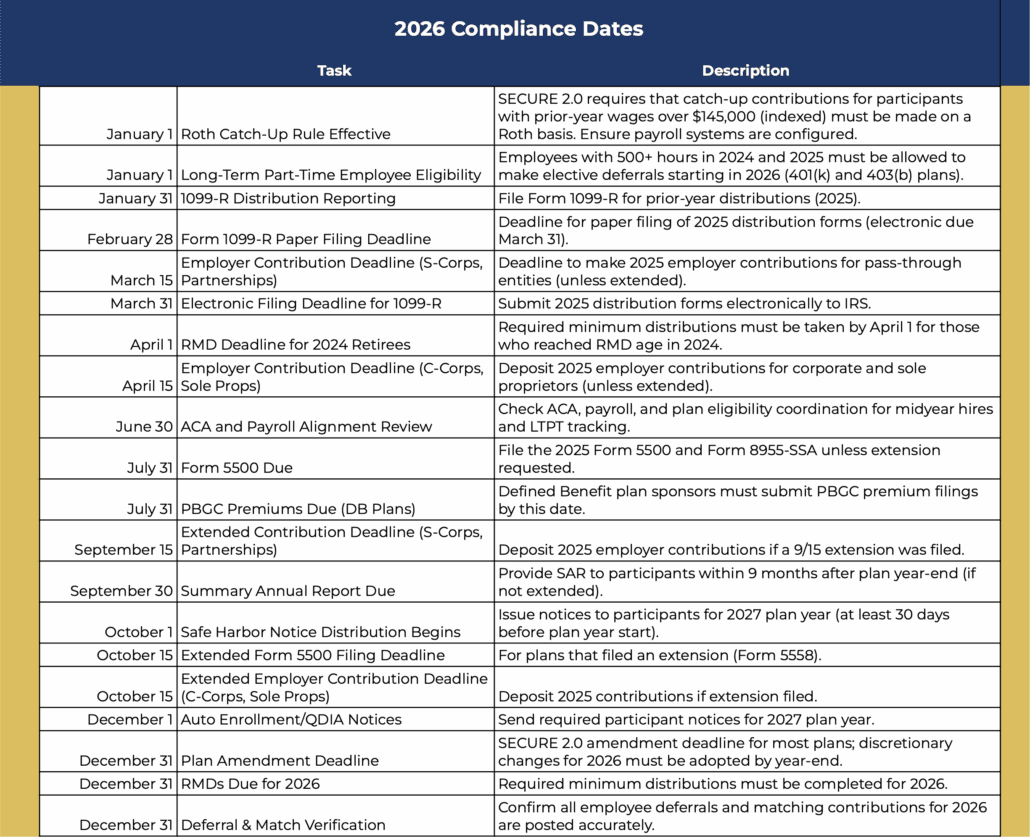
Deadline Event Description
January
1/31/25 Plan Census Data from sponsor required for annual nondiscrimination testing for calendar year-end due to Atessa Benefits.
Form 1099-R 2024 Form 1099-R to report Plan Distributions due to participants.
March
3/15/25 Corrective Distributions Corrective Distributions: Deadline for ADP/ACP refunds to HCEs are due to avoid 10% excise tax on the employer. Deadline is 2 ½ months after plan year-end.
New Traditional 401k Plan Deadline to adopt a traditional 401k plan for prior year 2024 (S-Corps and Partnerships or LLCs taxed as either one) only-For unextended Co. tax returns
Deductible Contributions Partnership and S-Corp (or LLC taxed as S-Corp) tax return is due, and deductible employer contribution is due unless plan files for a 6 month extension (Form 1065/Form 7004).
April
4/1/25 Required Minimum Distributions (RMDs) Initial Required Minimum Distribution due to terminated participants who attained age 73 in the previous plan year or those past 73 who terminated in the previous plan year.
4/15/25 Excess Deferrals 402(g) distributions of excess deferral are due to participants.
New Traditional 401k Plan Deadline to adopt a traditional 401k plan for prior year 2024 (C-Corps and Sole props or LLCs taxed as either one) only – for unextended company tax returns
Deductible Contributions C-Corporation (or LLC taxed as C-Corp) and Sole Prop tax return is due, and deductible employer contribution is due unless plan files for a 6 month extension (Form 1120/Form 7004).
June
6/30/25 Corrective Distributions Deadline for ADP/ACP refunds to HCEs for EACA plans to avoid 10% excise tax on the company. Deadline is 6 months after plan year-end.
July
7/31/25 Form 5500 File Form 5500 with the DOL. Due 7 months after calendar plan year end without an extension.
Form 5330 File Form 5330 with the IRS to report excise taxes related to prohibited transactions. Due 7 months after plan year end without an extension.
Form 5558 File Form 5558 with the IRS (Application for Extension of Time to File Certain Employee Plan Returns) is due to request a 2 ½ month extension on the Form 5500, 8955-SSA, and 5330. Form 5558 is due 7 months after plan year end.
Form 8955-SSA File Form 8955-SSA with the IRS via the FIRE SYSTEM. Atessa Benefits files on behalf of plan. Due 7 months after plan year end without an extension.
September
9/15/25 Deductible Contributions Prior year deductible contribution for Partnership and S-Corp (or LLC taxed as S-Corp) filers is due if an extension was timely filed.
New Traditional 401k Plan Deadline to adopt a traditional 401k plan for prior year 2024 (S-Corps and Partnerships or LLCs taxed as either one) only- if CO. tax filing was extended.
9/30/25 Summary Annual Report (SAR) Summary Annual Reports are due the be distributed to participants 9 months after plan year end. This is the due date if the Form 5500 was not extended.
October
10/1/25 Safe Harbor Notice Earliest date Safe Harbor notices due to participants 30-90 days prior to plan year end.
New Safe Harbor Plan Deadline to adopt a new Safe Harbor Plan for 2025.
Automatic Contribution Arrangement (ACA) Notice Earliest date Automatic Enrollment notices due to participants 30-90 days prior to plan year end.
Qualified Default Investment Alternative (QDIA) Notice Earliest date QDIA notice due to participants 30-90 days prior to plan year end.
10/15/25 Form 5500Final deadline to file Form 5500, if it was extended by having timely filed the Form 5558.
Form 8955-SSA Final deadline to file Form 8955-SSA, if it was extended by having timely filed the Form 5558.
New Traditional 401k Plan Deadline to adopt a traditional 401k plan for prior year 2024 (C-Corps and Sole props or LLCs taxed as either one) only – if CO. tax filing was extended.
Deductible Contributions Prior year deductible contribution for C-Corporation (or LLC taxed as C-Corp) filers is due if an extension was timely filed.
Corrective Amendments Plan has 9½ months after plan year end to make corrective amendment to cure a failed coverage test.
November
11/2/25 Simple IRA to 401(k) Plan switch Deadline to Notify SIMPLE IRA participants their plan will terminate Dec 31, in order to adopt a new 401(k) plan for 2026.
11/15/25 Required Minimum Distributions (RMD) RMD calculations begin – Annual recurring RMD distributions are due to participants 73 and older. Administratively, checks may need to be processed well prior to 12/31, so that the checks are dated in 2025.
December
12/1/25 Safe Harbor Notice Final deadline for Safe Harbor match notice to be provided to Plan Participants. Notice is optional for Safe Harbor non-elective plans under SECURE 2.0, unless the employer intends to make mid-year changes to the contribution.
QDIA Notice Final deadline for QDIA notices to be provided to Plan Participants.
ACA Notice Final deadline for ACA notices to be provided to Plan Participants.
12/2/25 Existing 401(k) Plan to Safe Harbor Match Notice Deadline to notify plan participants that the traditional 401(k) Plan will be converted to a SH match. Notices must be handed out today.
Existing 401(k) Plan to 3% Safe Harbor Non-Elective Deadline to adopt the required amendments to covert a traditional 401(k) plan to a 3% non-elective safe harbor for 2025.
12/15/25 Summary Annual Report Final deadline to provide the SAR to Plan Participants if the Form 5500 was timely extended.
12/31/25 Required Minimum Distributions (RMD) Last day RMD checks can be issued
Corrective Distributions Final deadline for ADP/ACP corrections for previous plan year to maintain qualified status. The 10% excise tax applies.
Existing 401(k) Plan to Safe Harbor Amendment Deadline to amend a traditional 401(k) Plan to convert to a SH match for next year 2026.
Existing 401(k) Plan to Safe Harbor Non-Elective for 2024 Amendment Deadline to adopt the required amendments to convert a traditional 401(k) plan to a 4% non-elective safe harbor for 2024.
To be distributed on a continuous basis…
Annually Participant Fee Disclosure Beginning in August 2012, participant fee disclosures must be distributed to participants and beneficiaries once each 12-month period.
As needed Participant Fee Disclosure/Fund Change Any update to the fee information or change to the fund line‑up requires a notice 30-90 days prior to the effective date of the change.
Immediately Summary Plan Description (SPD) To be distributed immediately after participant becomes eligible (within 90 days of entry), and if changes are made to the plan, due 210 days following end of plan year in which the amendment is put into effect.

An ancient Mirador on a hill with a clear view representing Transitioning a retirement plan to Mirador

One key responsibility for businesses offering 401(k) and 403(b) plans is ensuring employee contributions and loan repayments are deposited on time. The Department of Labor (DOL) and IRS closely monitor these transactions, and failing to deposit funds promptly can lead to compliance issues, penalties, and even plan disqualification.

How Soon Do Deposits Need to Be Made?

The general rule is that employee contributions and loan repayments must be deposited as soon as they can reasonably be separated from the company’s general assets. Here’s how that breaks down:

  • For plans with fewer than 100 participants: Deposits made within 7 business days after payroll are considered timely.
  • For plans with 100+ participants: Deposits must be made as soon as possible—often within a day or two after payroll.

Waiting too long—whether due to cash flow delays, payroll process issues, or simple oversight—can create an operational failure that requires correction and could trigger an audit.

What Happens If Deposits Are Late?

Late contributions are flagged on Form 5500, making them a potential red flag for the IRS and DOL. Late deposits can also result in:

  • Lost earnings for employees, which must be calculated and repaid.
  • Excise taxes and penalties on the employer.
  • Increased scrutiny in audits and possible legal risks from participants.

How to Fix Late Deposits

If you’ve missed a deposit deadline, there are ways to correct the issue:

  1. Self-Correction (SCP) – Identify the late deposits, calculate lost earnings, and document process improvements.
  2. Voluntary Correction (VCP) – Report the issue to the IRS and pay a fee to avoid heavier penalties.
  3. DOL Correction (VFCP) – Submit a correction to the DOL, which may waive excise taxes in some cases.

How to Prevent Late Deposits

Set a deposit schedule – Align contributions with your payroll tax payment schedule.
Designate a backup person – Ensure someone else knows the process if your payroll manager is unavailable.
Use automated remittance – Work with a TPA, payroll provider, or financial advisor to streamline the process.

Keeping deposits timely isn’t just a compliance issue—it’s about protecting your employees’ retirement savings and keeping your plan running smoothly. Need guidance? Talk to your TPA or financial advisor to ensure your deposit process is on track.

When planning for retirement, one of the biggest questions business owners ask is: How much can I contribute to my retirement plan? While it might seem like a simple question based on total earnings, the IRS sets strict rules about what type of income qualifies for retirement contributions. The key distinction? Only earned income counts.

What is Earned Income?

Earned income is money you make from actively working. It includes:

  • W-2 wages or salaries
  • Self-employment income
  • Commissions and bonuses

This income is subject to FICA and Medicare taxes, which is why the IRS allows it to be used as the basis for retirement plan contributions. Whether you’re contributing to a 401(k), Defined Benefit Plan, or pension plan, your contribution limits are based only on this type of income.

What is Passive Income?

Passive income is money that comes from investments or business activities that don’t require your direct involvement. Examples include:

  • Rental income
  • Interest and dividend income
  • Capital gains
  • Business income from an LLC or S-Corp (in some cases)

Because passive income isn’t tied to active work, it does not count when calculating retirement contributions. The IRS assumes that passive income sources, like rental properties or investments, will continue generating income in retirement, making additional tax-advantaged contributions unnecessary.

The K-1 Complexity

If you’re a business owner receiving income through a K-1, the distinction between earned and passive income can be more complicated.

A K-1 reports partnership income, deductions, and credits for tax purposes. While many K-1s only report passive income, others may include self-employment income—which is considered earned income and can be used to calculate retirement contributions. Look at Box 14 of your K-1 to see if it includes self-employment earnings. If it does, that portion of your income may qualify.

Why This Matters for Your Retirement Plan

Understanding the difference between earned and passive income is essential when designing a retirement strategy that maximizes tax-advantaged savings. Many business owners assume they can contribute based on total income, but only earned income applies.

Contribution limits can be complex, and every situation is different. Working with an advisor can help ensure you’re maximizing your ability to save for retirement based on all allowable income sources.

Want a quick estimate of how much you can contribute? Check out our calculator to see what your annual contribution limit might be based on your income and age.